Dubai is one of the most culturally mixed cities in the world. People arrive with different languages, recipes, hospitality codes, and family tables. Yet one thing is immediately legible across difference: food is one of the oldest ways people welcome, teach, and remember.
That is why the culinary terrace in the Mohammed Bin Rashid Library outdoor proposal matters. It should not be understood as a food court or a vendor strip. It is stronger than that: a shared cultural table inside a public knowledge landscape.
The companion built-work case is Mohammed Bin Rashid Library Outdoor Enhancement. The civic stance behind it is also consistent with Public Space Is Not a Food Court.
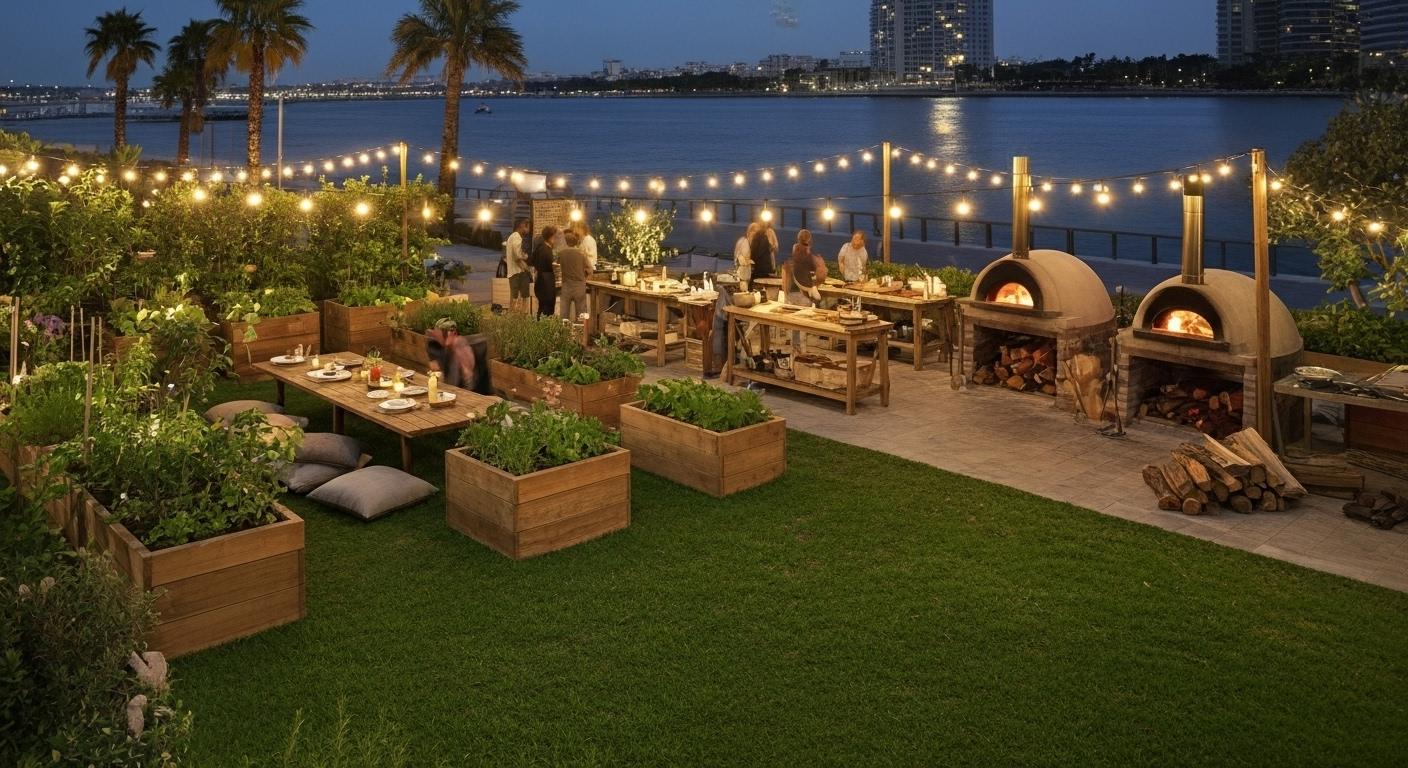
From service zone to cultural program
The usual outdoor F&B model is transactional. A place is judged by turnover, queue, vendor mix, and spend. That may support maintenance, but it does not automatically produce culture.
The terrace here proposes a different sequence:
| Old frame | New frame |
|---|---|
| Food trucks as vendors | Hosts and guest cooks as cultural storytellers |
| Customers buying a meal | Neighbors co-creating a shared table |
| Brand-led menu | Recipe exchange and heritage dishes |
| Transaction | Hospitality, memory, and learning |
This difference matters in a library setting. A library already exists to preserve and circulate knowledge. A shared culinary terrace lets another kind of knowledge circulate in public: taste, ritual, etiquette, memory, and adaptation across cultures.
What food teaches that text alone does not
Food carries more than nutrition. It carries:
- generosity
- sequence
- family memory
- local adaptation
- embodied hospitality
People can disagree on ideology and still understand how to pass bread, wait for elders, offer tea, or explain a spice mix from home. That is why food is often a better bridge than formal cultural messaging. It gives strangers a task, a rhythm, and a reason to linger without forcing sameness.
In Dubai especially, where many people live between places, a public table can do a rare civic job: make belonging practice-based instead of slogan-based.
The right spatial setup
For that to happen, the space cannot be only seating plus vendors. It needs a sequence that supports participation:
- Raised herb beds so growing becomes part of the lesson
- Open prep tables so knowledge is demonstrated, not hidden
- Shared heat sources like wood-fired ovens that pull people together
- Long communal tables that privilege exchange over private consumption
- A night setting that feels special without becoming exclusive
These are design decisions, not event decorations. The architecture determines whether people merely consume side by side or actually enter a shared ritual.
Why this belongs at a library
The strongest reason is institutional, not atmospheric. Libraries classify, preserve, and circulate formal knowledge. But public intelligence is not only formal. It also lives in recipes, gestures, hosting customs, growing practices, and the way families pass technique across generations.
When a library makes room for that kind of exchange outdoors, it refuses a narrow idea of what knowledge looks like. The institution says, in effect, that reading and research matter, but so do cooking, sharing, remembering, and meeting.
That is especially important in a city like Dubai, where migration shapes daily life. A shared table allows people to enter one another's worlds through taste and work, not only through representation.
Program ideas that fit the space
The terrace can support several formats without losing its core logic:
| Format | What people learn | Tone |
|---|---|---|
| Heritage night | One table, one tradition, one hosting code | Deep and respectful |
| Recipe exchange | How dishes change across homes and regions | Peer to peer |
| Herb harvest workshop | Growing, cutting, and cooking with fresh produce | Hands-on |
| Wood-fire bread circle | Shared dough, shared oven, shared result | Ritual and communal |
| Family table | Children and elders cooking together | Intergenerational |
| Seasonal festival | A recurring city invitation | Public and celebratory |
What matters is that these events leave residue: a remembered dish, a new friendship, a written-down recipe, a story repeated at home. That residue is cultural value.
The standard that keeps it honest
To keep the terrace from collapsing back into lifestyle branding, a few rules need to stay firm:
- hospitality over transaction
- participation over passive consumption
- many cultures across the year, not one symbolic showcase
- comfort designed for evening use
- memory and relationship as outcomes, not only attendance
If those rules hold, food becomes a civic teacher rather than a commercial add-on.
Closing
A library keeps books so knowledge can travel through time. A shared table lets knowledge travel through people.
When families harvest herbs, knead dough, pass dishes, and explain where a recipe came from, culture is not being displayed from a safe distance. It is being practiced in public.
That is what makes the culinary terrace worth designing carefully. It is not an amenity. It is a social form of learning.